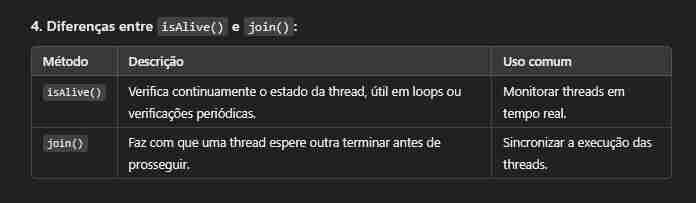
1。检查线程是否完成的方法:
isalive()
- 如果线程仍在运行则返回true;否则,返回 false。
- 用于持续检查线程的状态。
加入()
- 使调用该方法的线程等待,直到指定线程完成。
- 有多种变体允许您定义最长等待时间。
2。使用 isalive() 的示例:
// verifica se as threads estão vivas
class mythread implements runnable {
    thread thrd;

    mythread(string name) {
        thrd = new thread(this, name);
        thrd.start(); // inicia a thread
    }

    public void run() {
        system.out.println(thrd.getname() + " starting.");
        try {
            for (int count = 0; count < 10; count++) {
                thread.sleep(400); // suspende a execução por 400ms
                system.out.println("in " + thrd.getname() + ", count is " + count);
            }
        } catch (interruptedexception exc) {
            system.out.println(thrd.getname() + " interrupted.");
        }
        system.out.println(thrd.getname() + " terminating.");
    }
}

class morethreads {
    public static void main(string[] args) {
        system.out.println("main thread starting.");
        mythread mt1 = new mythread("child #1");
        mythread mt2 = new mythread("child #2");
        mythread mt3 = new mythread("child #3");

        // verifica se as threads ainda estão vivas
        do {
            system.out.print(".");
            try {
                thread.sleep(100);
            } catch (interruptedexception exc) {
                system.out.println("main thread interrupted.");
            }
        } while (mt1.thrd.isalive() || mt2.thrd.isalive() || mt3.thrd.isalive());

        system.out.println("main thread ending.");
    }
}
重要要点:
- 主线程不断检查 isalive() 直到所有子线程都完成。
- 线程的执行是由 java 调度的,因此确切的输出可能会有所不同。
3。使用 join() 的示例:

// aguarda o término das threads com join()
class mythread implements runnable {
    thread thrd;

    mythread(string name) {
        thrd = new thread(this, name);
        thrd.start(); // inicia a thread
    }

    public void run() {
        system.out.println(thrd.getname() + " starting.");
        try {
            for (int count = 0; count < 10; count++) {
                thread.sleep(400); // suspende a execução por 400ms
                system.out.println("in " + thrd.getname() + ", count is " + count);
            }
        } catch (interruptedexception exc) {
            system.out.println(thrd.getname() + " interrupted.");
        }
        system.out.println(thrd.getname() + " terminating.");
    }
}

class jointhreads {
    public static void main(string[] args) {
        system.out.println("main thread starting.");
        mythread mt1 = new mythread("child #1");
        mythread mt2 = new mythread("child #2");
        mythread mt3 = new mythread("child #3");

        try {
            mt1.thrd.join(); // aguarda child #1 terminar
            system.out.println("child #1 joined.");
            mt2.thrd.join(); // aguarda child #2 terminar
            system.out.println("child #2 joined.");
            mt3.thrd.join(); // aguarda child #3 terminar
            system.out.println("child #3 joined.");
        } catch (interruptedexception exc) {
            system.out.println("main thread interrupted.");
        }

        system.out.println("main thread ending.");
    }
}
预期输出(可能会有所不同):
Main thread starting.
Child #1 starting.
Child #2 starting.
Child #3 starting.
In Child #1, count is 0
In Child #2, count is 0
In Child #3, count is 0
...
Child #1 terminating.
Child #1 joined.
Child #2 terminating.
Child #2 joined.
Child #3 terminating.
Child #3 joined.
Main thread ending.
重要要点:
- join() 确保主线程仅在子线程完成后继续。
- 输出显示每个线程按预期顺序终止。